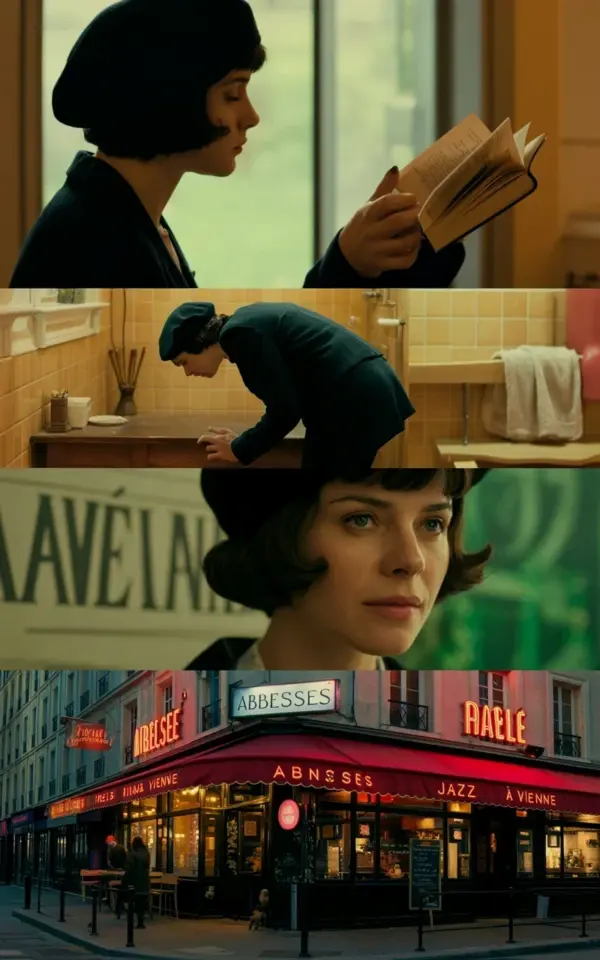
Four panels of light, and not one of them wasted. This Amélie collage looks like something pulled from a contact sheet you would be nervous to cut into, and honestly, film photography people, you know exactly what I mean. The image sits somewhere between memory and mood board, four small fragments of 2001 cinema that still smell like darkroom chemicals to me. It is the kind of thing you stare at while your prints dry, then stare at again because you realized you missed a shadow.
The top left panel shows her profile under a black beret, eyes lowered toward an open book. Top middle, she bends over a wooden table, a white towel draped somewhere in the background, motion caught mid-thought. Top right is the close-up, short dark hair falling against her face, a quiet expression that holds your attention longer than it should. And then there is the bottom strip, a street-level view of a Parisian café at night with neon signs buzzing warm, the kind of glow you want to step into. Keep these details in your head because every section below borrows from them.
Why this collage works like a film photography contact sheet
A contact sheet is not meant to be beautiful, but this one is. The collage reads like a roll of fresh Perceptol-ish energy, the way a photographer scans four rows of frames and suddenly sees a story between the sprocket holes. That is what makes it so easy to rebuild as a mood board for darkroom inspiration. Each panel isolates one element of visual craft, a profile, a gesture, a face, a street, and that division feels deeply analog.
You do not get this from digital photography. Digital gives you a screen, a histogram, a string of nearly identical exposures. Film gives you the opposite, four moments, each one different because the light shifted or the person moved. This Amélie collage, in its four separate windows, recreates that exact texture.
The black beret profile is a whole portrait aesthetic
The profile with the black beret and the open book deserves its own Pinterest board, no arguments taken. It is absurdly simple, one person, one hat, one bound object, and yet the composition is richer than most full-set shoots I have seen. The beret does not do much physically, it frames the face, adds a little sculpture to otherwise clean hair, but spiritually it carries the entire vibe of the film.
I bought a beret once at a street market in Montmartre, brought it home, and let it sit on a dusty porcelain bust for two years. It never made me look like Audrey Tautou, obviously, but it did solve a portrait problem I had been ignoring. For a film photography portrait session, put the subject in profile, give them a book to actually read, and wait. Let them forget you are holding a camera. The beret softens the chin line, the book tilts the head naturally, and the light on the cheekbone does the rest.
The wooden table scene and honest inside light
Top middle is my favorite panel because it is so unglamorous. Amélie bends over a wooden table, a white towel hanging somewhere behind her, and nothing about the scene is staged beyond the frame itself. That is the thing about film photography in real apartments, the light is what makes a boring corner compelling, not the furniture. This particular corner works because the light enters from a window at an angle, catches the top of the table, and turns a towel into a shape.
Shoot this scene yourself with a 50mm lens around f/2 and do not straighten the frame. A slight tilt adds motion. Keep your shutter speed at 1/60 and fall back on the grain to hide the handheld shake. The white towel in the background will blow out slightly, and that is part of the mood. Perfection in this kind of frame is a lie, the truth is the dust on the table and the way she holds her shoulders.
The contemplative close-up, the one people skip
Everyone talks about the café, the glass, the crème brûlée, and the garden gnome. Hardly anyone mentions the close-up of Amélie’s face with her short dark hair and that inward-looking expression. This panel is the quiet one, and it has taught me more about available-light portraiture than any glossy makeup shot ever did. There is no key light screaming for attention, just a face catching whatever filtered daylight was left in the room, plus a little tungsten falloff from somewhere off-frame.
As a film photography exercise, try this with a single window light and a silver reflector, or honestly, no reflector at all. The contemplative look works because the subject is not posing for the camera, she is somewhere else entirely. Wait for that drifting moment, shoot it on Portra 400 at box speed, and do not crop. Let the darkness at the edge of the frame say its piece.
The Parisian café at night, pure neon cinema energy
The bottom panel is where the collage grows teeth. A street-level view of a Parisian café at night, neon signs glowing through a blue hour that never quite gives up, this is the frame that makes you want to book a flight and also develop film in a foreign bathroom sink. The colors matter here, the cold blue of the street against the warm orange and red of the sign, the whole classic warm-cool split that every movie poster steals from.
For your own night scenes, try Cinestill 800T. It handles neon like nothing else, halation blooms around each sign and the shadows stay deep and moody. Push it one stop if you are shooting handheld under a café awning. If you do not have Cinestill, green-tinted neon that is almost radioactive makes it feel like a darkroom print. There are two moments of chaos in the frame, a beret with a red band, exactly like the one above but somehow more tactile. Plaster a print to your fridge. Do not frame it, just let it mark the edges and fade slightly in the weeks between darkroom sessions.
Build your own Amélie film photography mood board
Round up your prints, your test strips, maybe a broken negative sleeve, and make a collage that would make Jeunet nod in approval. A good mood board pulls from the same four visual cues, the beret, the apartment table, the close-up face, and the neon street. These are not heavy props, they are small signals that nudge the eye toward a whole aesthetic.
– A short haircut plus a warm wool coat in one print
– The corner of a café table with a glass of wine, half empty
– A red lampshade burning against a blue twilight, trust the contrast
– A window with rain spots and a silhouette small enough to be unimportant
– A strip of film negatives held up to light, scanned, unretouched
Use whatever mix of them fits your archive. The collage does not have to look like the movie, it just has to feel like the first time you watched it. That is the whole point of a movement, no matter how dim the projector gets, the images outside the window keep glowing, tucked into a book or pinned onto the wall above your desk. Go print something. The night will not develop itself.
Leave a Comment