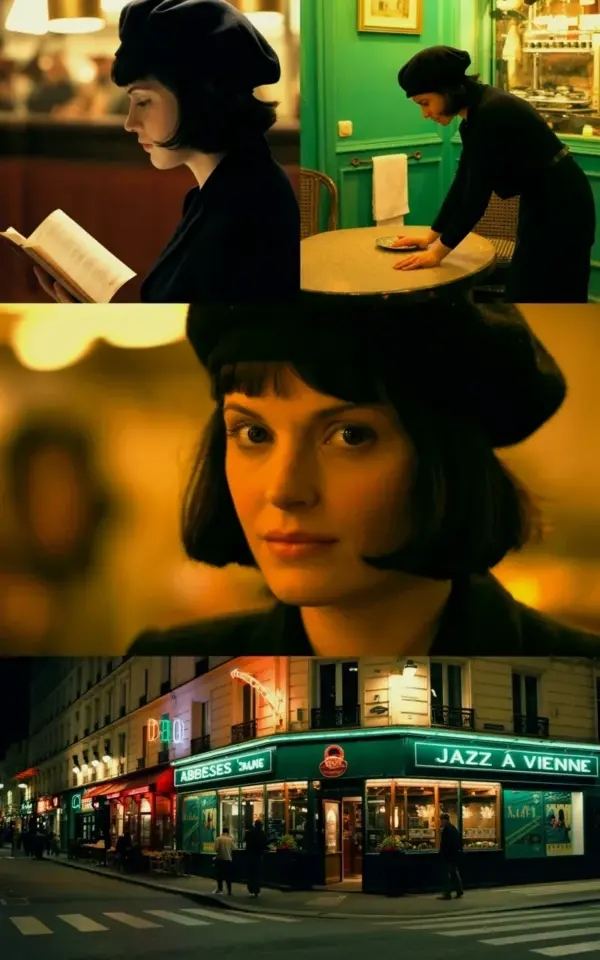
If you are looking for pure film photography inspiration, stop scrolling. The movie Amélie (2001) is basically a masterclass in how to capture everyday life with warmth, curiosity, and a little bit of magic. This cinematic collage from the film shows exactly what I mean: Amélie reading in a black beret, bending over a wooden table, a quiet close-up of her face, and that neon-lit Parisian café at night. Every frame feels intentional, but not stiff. And that is exactly where most of us mess up when we try to shoot film. We overthink, we force the mood, or we forget that the best stills come from the same mistakes the movie quietly avoided. Let me walk through the most common traps and how to dodge them, using this very collage as your guide.
Overcomplicating Street Film Photography Composition (When You Should Just Look)
That top left panel of Amélie in profile, reading? It looks effortless. But if you tried to set it up yourself, you would probably move her three inches to the left, change the lighting, and end up with something stiff. The mistake is thinking street filmphotography composition needs perfect geometry or leading lines. It does not. In Amélie, the composition works because the subject is genuinely absorbed. The beret, the book, the soft side light: they are all there, but none of it feels arranged.
How to fix it: Next time you are out with your camera, find a person doing something real. Do not ask them to pose. Just frame them naturally, let the environment fill the edges, and shoot when the moment feels right. Use the rule of thirds as a loose guide, not a rule. If the composition feels a little off-center, good. That is life.
Achieving Warm Tones Without Over-Saturating Your Film Scans
The warm tones in this collage are iconic. But here is the mistake: people try to mimic that amber glow by cranking up saturation in post, which just makes skin look orange and fake. The secret is not digital color grading; it is the film stock and the light itself. In Amélie, the warm palette comes from a combination of tungsten lighting, golden-hour bounce, and the specific Fuji film stock used.
- Choose the right stock: Go for Kodak Portra 400 or Fuji Pro 400H for that subtle warmth. They handle warm tones without blowing out highlights.
- Use natural warm light: Shoot in the hour before sunset, or near incandescent lamps. The café neon in the bottom panel casts a different kind of warmth: mix it with the street glow.
- Scan properly: If your lab scans too cool, ask for a warmer white balance. A tiny tilt toward yellow or orange can recreate that movie feel without overdoing it.
The result? A soft, nostalgic parisian warmth that looks like it came straight from the negative, not from a slider.
Why You Need Close-Up Film Photography Techniques (And How to Not Make Them Creepy)
Look at the top right panel: a tight close-up of Amélie's face, short dark hair, contemplative expression. That shot would be invasive if it were not intimate. The common mistake is jamming a 50mm lens two feet away from a stranger's face and expecting magic. Close-ups in cinematography require trust and context. In this movie, we have seen her read, we have seen her walk through Paris, so that close-up feels earned.
How to pull it off: Start by shooting people you know, or at least have chatted with for a few minutes. Use a slightly longer lens (85mm or 100mm) so you can stay a respectful distance but still fill the frame. Focus on the eyes, but do not be afraid to cut off the top of the head. Amélie's face fills the frame, and that boldness is exactly what most photographers shy away from. Try it: take a few steps back, zoom in, and wait until the person looks away or into middle distance. That is when the real emotion shows up.
Embracing Soft Focus Without Apologizing for It
Every time I see a film photo that is slightly out of focus, the photographer apologizes. Stop that. In Amélie, the soft focus is a deliberate choice to create a dreamy, nostalgic atmosphere. The mistake is thinking every image has to be tack sharp. The top middle panel of Amélie bending over a wooden table has a gentle blur around the edges that draws your eye to the center. That is not a mistake; that is a technique.
How to use soft focus intentionally: Shoot wide open (f/1.4 to f/2.0) with a fast prime lens. Let the depth of field be shallow enough that only the subject's face or hands are sharp. Or try zone focusing: set your lens to a certain distance and let the rest go soft. Do not try to fix softness in editing. Instead, lean into it. Pair it with high-speed film (ISO 800 or 1600) for grain that adds texture. That is how you get the movieinspo vibe without trying too hard.
Capturing a Parisian Café at Night Without Blowing Out the Neon
The bottom panel of this collage shows a street-level view of a Parisian café at night, neon signs glowing, warm light spilling onto the pavement. Most night film photographers make one of two mistakes: they underexpose and get a black mess, or they overexpose and turn the neon into a white blob. The key is balancing the bright signs with the dark surroundings, just like the movie does.
Practical tips for night film photography:
- Use a fast lens (f/1.4 or f/2) and a tripod to avoid camera shake. The café's ambient light will be enough for a 1/30th second exposure.
- Meter for the neon sign, not the dark street. Let the shadows fall where they may. That creates the contrast that makes the café glow.
- Push your film one stop if you are shooting ISO 400. Push it to 800 to get more contrast and grain, which matches the gritty yet romantic feel of Paris after dark.
- Do not be afraid of empty space. The bottom frame has a lot of dark pavement, but it gives weight to the neon. Less is often more.
Next time you are in any city, not just Paris, find a corner café with red or blue neon. Wait until the street is quiet. Compose low, including some reflection from the wet street if possible. That is your parisian moment, even if you are in Brooklyn.
Not Telling a Story With a Series of Frames (The Mistake of Shooting Only One Shot)
This collage itself is the lesson. Four scenes, each different, together tell a complete story. The mistake most film photographers make is they shoot one single beautiful image, then pack up. But the magic of Amélie is how the shots relate to one another. The profile reading, the bend over the table, the close-up, the café: together they feel like a short film. You can do the same with a roll of 36 exposures.
How to shoot a mini story: Pick a theme for your next roll. Maybe it is “a person reading in different spots” or “one café from inside and out.” Start with an establishing shot (the street), then a medium shot (person at table), then a detail (hands, book, beret), then a close-up (face). Do not repeat the same frame. Let each image add a new piece of information. When you look at the contact sheet, you will see a narrative emerge. That is how you turn a roll of film into a mini movie, and that is exactly what filmphotography should feel like.
So next time you head out with a roll of Portra and a camera, remember the collage. Do not overthink the composition. Let the warmth come from the light, not the editing. Get close, but earn it. Let the focus go soft when it wants to. Meter for the neon, and shoot a series, not just a single image. Those are the small shifts that separate a snap from something that feels like a still from a beloved film.
Now grab your camera, put on a beret for fun, and go find your own Parisian moment. And when you do, tag it with #movieinspo and #filmphotography. I would love to see what you make.
#filmphotography #cinematography #parisian #movieinspo #amélie
Leave a Comment