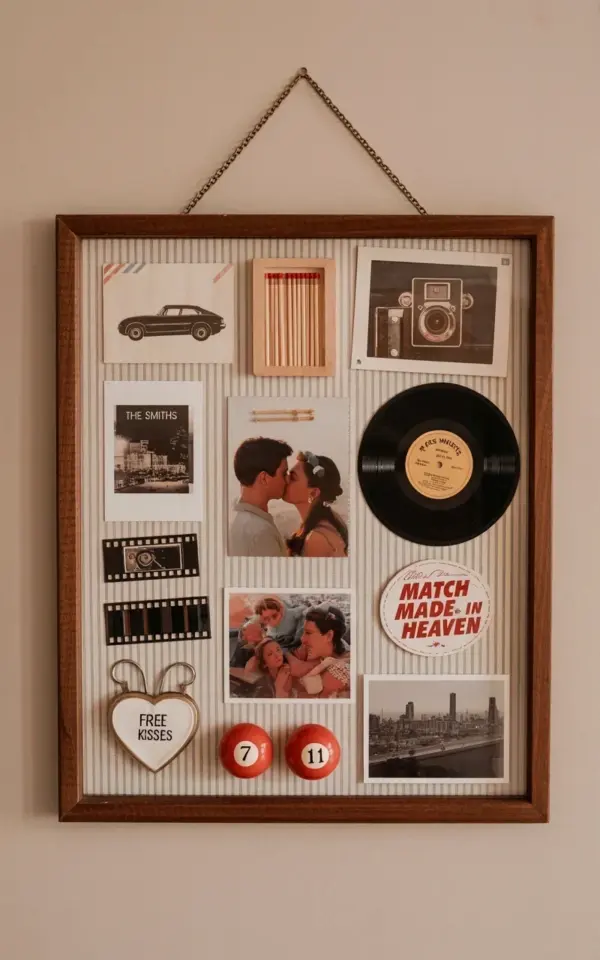
Eight black-and-white photos from one roll of film, thirty years of dust, and a red pool ball with the number 7 on it. That is what this entire idea started from, and honestly, it changed how I think about frames. Making a vintage camera memory collage does not require perfect composition or expensive archival supplies. It requires you to stop throwing things away and start pinning them next to each other.
The collage in the photo is a happy accident of unrelated objects. There is a black car illustration, a heart-shaped locket, used matchsticks, and a Smiths album cover leaning against a vintage camera photograph. It all sits on striped gray and white wallpaper inside a dark wooden frame. The effect works because nothing matches, and that is exactly the point. Here is a collection of themes you can build your own memory board around.
Vintage Camera Photo Collage Ideas for a Gallery Wall
If you have an old family photograph of someone holding a camera, use that as your anchor. Good. Now build everything else around that single image, because it will keep the whole board from feeling scattered.
In this specific arrangement, the vintage camera photo is the literal centerpiece. It sits near the middle, holding the composition down while the other pieces orbit around it. A large black vinyl record behind it adds weight and gives the eye a dark shape to rest on.
You do not need a dedicated gallery wall for this. One frame on a beige wall, like the one in the photo, reads as intentional and calm. The wallpaper backing does a lot of the work here. A busy photograph behind everything would have turned this into chaos. But a striped pattern adds structure without shouting.
If you do not have a vintage camera photo, print one from the internet and treat it with a sepia filter. Nobody will know the difference. Or, even better, use a photo of your grandfather holding his old Nikon, something with personal history.
Vintage Paper Ephemera and Music Memorabilia in a Memory Collage
Paper goods are the easiest things to collect for this craft because they cost nothing and mean everything. A postcard envelope, a matchbook, a ticket stub from a concert you saw in 2009. These items carry memory with very little visual effort.
The Smiths album cover in this collage is a perfect example. You do not need to be a Morrissey fan to appreciate how the black and white portrait breaks up all the red and cream tones in the frame. It provides contrast and a little bit of teenage angst, which every good memory board needs.
Listen. Do not overthink the music part. A vinyl record sleeve looks great leaning against the back of the frame, but you can also use a cd booklet or a printed playlist cover. The point is to include something that represents your taste at a specific moment in time. In this case, the Smiths album did that for whoever made this board.
That classic album cover would not have worked if everything else in the frame was pristine and modern. So keep your paper pieces slightly worn. Fold the edges. Let the corners yellow.
Repurposed Found Objects in a Themed Memory Board
Found objects are what separate these boards from flat scrapbook pages. In this collage, the red pool balls are the standout examples. Two red pool balls, numbered 7 and 11, sit at the bottom like tiny sculptures, they add dimension and weight to the whole piece.
Pool balls are glossy and heavy. But you can use anything with a little mass. Old keys. A locket. A small die from a board game. A badge or pin from a festival. In this collage, a heart-shaped locket with photographs hangs from the top, which mixes metal and glass into the composition.
Honestly, the “free kisses” sticker and the “Match Made In Heaven” matchbook are the kind of silly little items that give the whole frame personality. They break the seriousness. They remind you this is not museum work, it is a memory board.
Keep the objects lightweight enough to attach. That seems obvious, but you would be surprised how many people try to glue a brick into a wooden frame.
Film Strip Negatives in a Vintage Photography Collage
Most people do not have physical film negatives anymore, which is precisely why they are so valuable in a collage like this. The jagged edges of the film strip create texture and suggest a story that exists outside the frame.
Here in this particular board, the film strips hang along the top, like little flags. This is a smart placement because it draws the eye upward and then around the other elements. Film strip negatives have a translucent quality, so they catch light differently than paper.
If you do not have actual negatives, you can print strips of film onto clear acetate or vellum paper at a copy shop. I did this once for a friend who wanted the look without the hassle. It works. The key is to use a font that looks like the numbers on real film edges, that small detail sells the illusion.
Film negatives also happen to pair beautifully with the striped wallpaper background. Both feel like they belong to a different decade, which is exactly the mood you want here.
How to Arrange Keepsakes Around an Old Photograph
Start with the old photo in the center and work outward. That is the rule, and rules make this kind of craft much easier. You will save yourself an hour of frustration if you just commit to this simple approach.
For this layout, the vintage camera photograph does the heavy lifting. It is the most recognizable object in the frame, so it earns the center position. The pool balls anchor the bottom, the Smiths album leans on the left, and the hanging locket fills the upper space. This creates a rough diamond shape with the photo at the center.
One practical tip I learned the hard way: lay everything out on your table first and photograph it with your phone. Do not fasten anything yet. Look at the photo you just took and ask yourself if your eyes know where to go. If not, shift things around. This ten minute step saves a lot of glue removing.
You are allowed to layer things. Let the film strips overlap the top of the camera photo. Let the postcard envelope sit partially under a matchbook. Collages look worse when every item floats in its own personal bubble.
Vintage Photography Decor in a Shadow Box Frame
A shadow box frame is the single best purchase you can make for this project. The extra depth gives you room for the pool balls and the locket and the matchstick pieces. I will never understand why people attempt these collages in a flat frame, it defeats the whole purpose.
The wooden frame in this photo is dark brown, which matches the vintage mood from the wallpaper down through the album cover. A black frame would have been too severe. A white frame would have looked too clean. The brown wood acts like a warm border, closing off the scene like a window into the past.
When you buy a shadow box, check the glass. Ordinary glass creates a glare that hides matte black items like vinyl records. Consider buying frames with non-glare glass or regular acrylic instead. It sounds fussy, but you will thank me later.
One more thing about the wooden frame: hang it at eye level. This is a detail people ignore, and then they wonder why nobody stops to look at their work. The board should be visible and accessible, not tucked away behind a plant.
Conclusion
This collage started with a camera photo and ended up holding pool balls, matchsticks, film negatives, and a Smiths record. That is the honest truth of it. You never know what belongs together until you put it on one surface and take a step back.
Pick a theme or skip the theme entirely. Gather your paper scraps and your weird little objects. Lay it all in a frame, adjust it a dozen times, and then let it be. Some memories are better when they are a little jumbled anyway.
Save this idea for your next craft day, and if you make your own vintage camera memory collage, hang it somewhere you will actually walk past every day. That is the only rule that really matters.
Leave a Comment