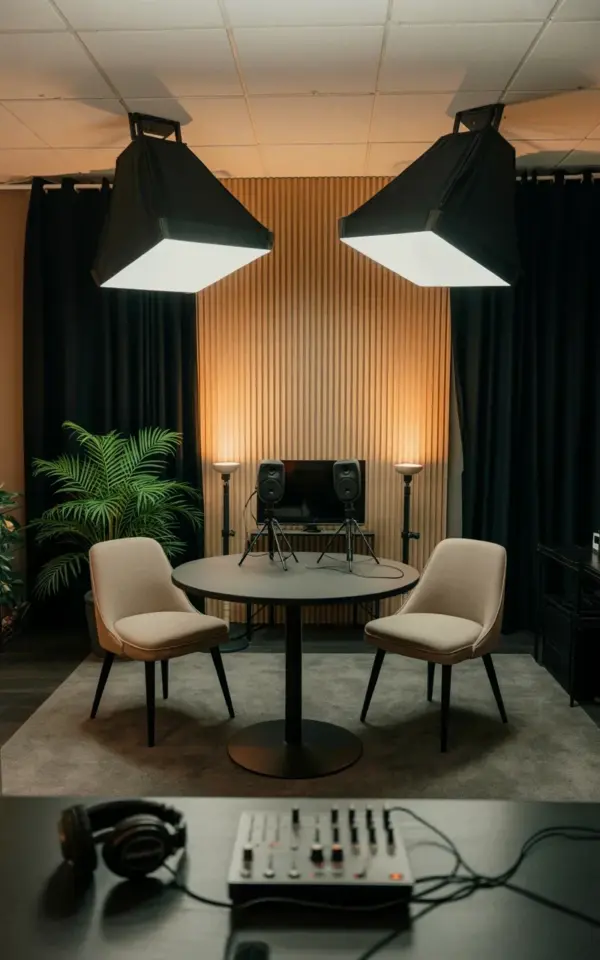
Right now, you’re probably staring at a Pinterest photo of a podcast studio setup and trying to figure out why this one looks so much more inviting than the corner of your bedroom. The round black table, the beige upholstered chairs, the two oversized softboxes hanging from the ceiling, the wood slat wall in the background, it all reads as professional but not cold. But here’s the thing: the magic is not just the look. It’s the way every single element in that photo, including the plant and the curtains, is pulling weight in a room that was clearly built for conversation.
Let’s break down what’s actually happening in this photo and what you can steal for your own space, even if your budget is nowhere near a full renovation. Not gonna lie, some of this you can fake for under fifty bucks.
Why the Round Table Is the Best Podcast Studio Setup Card You Can Play
The round table in the center is not just furniture. It’s a conversation tool. Round tables have no head, no power position, and no one gets stuck staring at the back of someone’s laptop. Eye contact goes around in a circle, and that changes the energy of an interview.
For a podcast studio setup, a round table also gives your guests a natural place to rest their hands and notes. The one in the photo is black, which disappears against the gear and cables. Smart. A glossy white table would bounce light around and reflect into your camera lens like a beacon.
Look, if you’re on a budget, a thrifted round table with a black tablecloth works exactly the same. The shape matters more than the price.
Hanging Softboxes and the Lighting That Doesn’t Get in Your Way
Those two large black softboxes are hanging from the ceiling, and honestly, that’s the smartest part of the whole picture. Floor-standing lights get kicked, bumped, and pushed into corners. They block your walkway and create shadows at the wrong moments. Ceiling-mounted softboxes stay out of the frame while giving you even, flattering light from above.
In the photo, the light falls evenly across the table and the chairs. Nobody looks half-shadowed or like they’re being interrogated. That’s the goal. For a home setup, you can clamp softboxes to a curtain rod or use a sturdy C-stand if you don’t want to drill into your ceiling. Just make sure the light is soft and large, not a tiny direct bulb that makes everyone look like a true crime suspect.
Wood Slat Panels and Acoustic Treatment, for Real
The vertical wooden slat panels on the wall are a textbook example of a podcast studio setup that looks good and sounds decent. But here’s the nuance: those slats are not magic soundproofing. They break up flat wall surfaces and tame some mid-range reflections, but they are not a replacement for actual acoustic treatment. The black curtains on either side are doing a lot more work than most people realize. Curtains catch flutter echo from windows and bare corners.
The dark gray carpet in the photo matters too. Hard floors bounce high frequencies around like table tennis, and that gives your voice a hollow, distant quality. Carpet, curtains, and wood slat panels together create a room that doesn’t echo.
If you’re short on funds, focus on the things that kill echo: thick movers blankets on the wall, a rug over hardwood, and something soft behind the microphone. Wood slat panels are a beautiful upgrade, but they are the last layer, not the whole treatment.
The Podcast Equipment That Matters Less Than You Think (and What Does)
The photo shows an audio mixer and a pair of headphones in the foreground, on a black desk. That gear is nice, but it is not the reason this studio works. You can have a $400 microphone and still sound like you’re recording at the bottom of a metal trash can if your room is live and echoey.
Before you buy another piece of podcast equipment, do this:
- Get the microphone close to your mouth, about six inches away, with a pop filter between you and it.
- Hang a moving blanket or a thick curtain on the wall directly behind your speaking position.
- Place acoustic panels at the first reflection points on the side walls, not just right behind the mic.
- Record a test clip and walk around the room while clapping. That will instantly show you where the echo lives.
That last one is not a joke. I once clapped in a friend’s “treated” studio and the room sounded like a cave. A hundred dollars of used acoustic foam fixed more than a new microphone ever could have.
Recording Studio Ideas for Home: Small Space, Big Fixes
This photo is aspirational because the room has dedicated corners: the plant in the left corner, the mixer in the foreground, the relaxed seating around the table. In a smaller home, you can still copy the layout by thinking in zones. Make one corner for the guest chairs, one corner for the gear, and one spot that is purely visual, like a plant or a framed poster.
A large green palm plant in the corner is a classic recording studio idea that costs almost nothing to copy. It breaks up a sharp corner and gives the eye somewhere to rest. It also does absolutely nothing for acoustics, but honestly, who cares. A studio that feels alive makes you want to show up and hit record.
For home studio inspiration, look for rooms with a clear rhythm: dark and warm materials, a few soft surfaces, and lighting that doesn’t fight your face. You don’t need a giant space. You need a space that doesn’t betray your voice.
The Plant, the Curtains, and the Seasonal Shift in Your Home Studio Inspiration
This particular studio has a cozy, late-autumn feeling. The walnut tones of the wood slat panels, the black curtains, the beige chairs, and the dark gray carpet all combine into something you’d want to sit in with a mug of tea. If you’re building your own room, think about the season you want your sessions to feel like. Warm wood and dark tones work year-round, but they hit hardest when the light outside is low.
Seasonal touches matter more than you’d think. In spring, you can swap the curtains for something lighter or add a different plant. In summer, you might pull the softboxes closer to the window and let natural light do half the work. This is the kind of home studio inspiration that keeps your space from feeling stale.
The palm plant in the corner is probably a rhapis or kentia palm, and I’m not here to be a botanist, I just like how it softens the angle. Put a plant near the edge of your frame and you’ll instantly look more professional, even if you’re recording at 2 a.m. in a spare bedroom.
Build Your Podcast Studio Setup Around the Workflow, Not the Vibe
At the end of the day, this room works because the layout matches the process. You sit down, you press record, you talk to your guest across a table that doesn’t feel like a conference table. The gear is close enough to reach but not so close that it becomes a mountain of blinking lights between you and your conversation.
Start with the practical moves: put acoustic panels in the spots that matter, place the microphone at mouth level, and set up your chair so you’re not twisting your neck to see a screen. Then, once the basics are solid, let the wood slat panels and the plants be the finishing touches they were meant to be.
Save this for your home studio ideas and start with the room, not the gear. Your voice will sound better for it.
Leave a Comment