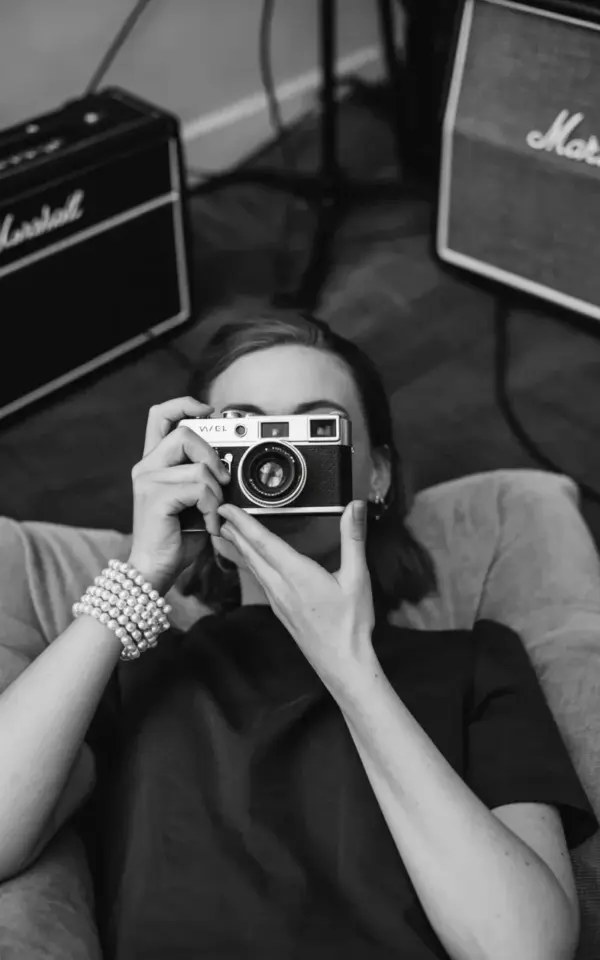
There’s something about a Leica mirror selfie that just sticks with you. Not gonna lie, I spent a whole afternoon trying to recreate one I saw online, and my first attempts were total garbage. Too bright, too flat, and I forgot to turn off the ceiling light. But once I figured out the ingredients, it clicked. That timeless feel is not magic, honestly it is a set of choices you can copy step by step. Let me show you how.
Why black and white works best for a vintage mirror selfie
Shooting in monochrome strips away all the noise. You know when you take a color photo in a messy room and your eye gets stuck on a red soda can? That does not happen here. The deep shadows and high contrast force the viewer straight to the subject, which is you and that classic camera. For my own Leica mirror selfie, I set my camera to black and white mode in-camera (most film Leicas do not have that option, but digital ones do). If you are using film, pick a high-contrast stock like Ilford HP5 Plus or Kodak Tri-X 400. They handle shadows beautifully and give you that old-school darkroom finish without needing a real enlarger.
Here is a weird detail I learned the hard way: expose for the shadows, not the highlights. Your face might be a little underexposed, but that is fine. The moody look comes from letting the dark areas stay dark. Do not fight it. Let the shadows eat part of your cheek or the side of your neck. It feels intentional, even if you were just too lazy to find a brighter room.
Setting up the shot: Leica, mirror, and that slightly elevated angle
Look, the photo we are talking about is taken from a slightly elevated angle, looking downward. That is not an accident. If you hold the camera straight on, you get a flat selfie that looks like you are in a video call. But when you tilt the camera a little, the mirror shows more of your arm, the camera body, and the background. It adds depth. I prop my Leica on a small stack of books to get the right height without my arm shaking. Then I stand a few feet back from the mirror so the whole thing feels composed, not cramped.
Do not use a selfie stick. Seriously. Just do not. The whole point is that old-school photographer pose where you hold the camera up to your face, almost like you are about to take a picture of someone else. That position looks natural because it is what we do every time we shoot. The mirror catches that reflex. And yes, you will probably have to take about thirty frames to get one where the camera does not block your eye completely. That is part of the process.
That pearl bracelet detail is not optional
Ok so in the original image, there is a pearl bracelet on the wrist. I thought it was a cute afterthought until I tried shooting without any jewelry and the photo felt flat. The bracelet catches the light in a specific way, a tiny glint that breaks up the dark top. You do not need pearls exactly. Try a silver chain, a single ring on a finger visible near the camera, even a watch with a reflective face. The trick is to have something small that creates a point of interest without pulling focus away from you or the Leica.
One time I used a chunky plastic bracelet from a flea market and it looked terrible. Too large. The pearl bracelet works because it is subtle. It almost disappears into the shadows until the right angle of light hits it. That is the goal. If you can, shoot near a window on an overcast day. The soft light will kiss that bracelet and leave the rest in glorious darkness. I also noticed that the light in the reference photo hits the bracelet from the side, not straight on. So angle your wrist a little away from the main light source.
- Use one small piece of jewelry, no more than two inches wide.
- Choose something with a matte or semi-gloss finish (avoid high-shine that blows out highlights).
- Position your wrist so the bracelet catches sidelight, not direct light from above.
The Marshall amplifier in the background adds texture and story
Not everyone has a Marshall amp lying around. That is fine. But the idea is to include something in the background that tells a tiny story. A Marshall amp says “I play music” or “I hang out in a space where things happen.” In my own photo, I used a beaten-up Fender amp that has a cracked handle. It is not pretty, but it adds grit. You could use a stack of vinyl records, a guitar case, a messy bookshelf, even a bicycle wheel leaning against the wall. The key is that it is partially visible, not the center of attention. The deep shadows will hide most of it anyway, which is perfect. A fully lit background kills the mood.
Here is a practical tip: shoot in a room with only one light source. A single lamp aimed at the side of your face works. Then the background falls into darkness and you only see fragments of the amp or whatever you placed there. That fragmentary look is what makes the photo feel like a snapshot from the 1960s, a moment caught in a dimly lit studio. Honestly, you could even use a cardboard box spray-painted black and nobody would know. The shadows disguise everything.
Posing with the camera: more than just hiding your face
The classic photographer pose has the Leica held up to your face, but there are variations. You can tilt the camera slightly to the side so one eye is visible, peeking around the lens. That was my favorite from a shoot last week. Or you can lower the camera a few inches so it covers your mouth but leaves your eyes exposed. Both feel intimate. Do not smile a big smile. A neutral expression or a slight smirk works better. This is a portrait about mood, not about showing teeth. And keep your shoulders relaxed. I used to tense up and my neck looked like a linebacker’s. Let your arm holding the camera bend naturally, maybe let the other hand rest on your hip or drop to your side.
A person I follow on Instagram always keeps her fingers visible on the lens ring. That little detail makes the photo feel more authentic, like you caught the photographer mid-action. So do not hide your fingers. Let them curl around the lens or the focus ring. The Leica is a beautiful object, show it off a little. And if you are using a film Leica, the sound of the shutter is satisfying, but that does not show up in a photo. But trust me, hearing that clack while you shoot adds to the whole ritual.
Editing for that old-school darkroom finish without Photoshop skills
I am not a pro at editing. But you do not need to be. For a black and white portrait, push the contrast up until the blacks are almost crushed and the whites are still holding detail. Then reduce the exposure slightly. In Snapseed or Lightroom mobile, the “structure” slider is your friend. A little structure (not clarity) adds texture to your skin and the camera body. Do not overdo it. Just a nudge. Also, add a slight grain. Modern digital cameras are too clean. Grain makes it look like film. Add about 20% grain at medium size. That tiny bit of noise fools the brain into thinking it is old.
Here is a trick I learned from a friend who develops his own film: do not make the highlights pure white. Keep a tiny amount of gray in the bright areas. Pure white looks digital. Leave a whisper of tone. And crop out anything that is too bright near the edges of the frame. That pulls the viewer’s eye back to you and the camera. Honestly, I spent way too long trying to fix a bright spot on the wall behind me before I realized I could just crop it out. Save yourself that agony.
Why this style works with any classic camera, not just Leica
Look, Leica cameras are expensive. I do not own one. I used a Fuji X-Pro2 with a vintage lens adapter and it gave me the same feeling. The magic is not the brand. It is the approach. The deep shadows, the single light source, the small reflective detail, the background fragment, the elevated angle. You can do this with any camera that has manual controls and a lens that lets you focus close enough. A Pentax K1000, a Canon AE-1, even a cheap old digital point-and-shoot in black and white mode. The key is the intention. Treat the photo like a darkroom project, even if you are just using your phone. I have seen people get close using the “Prism” filter on Instagram and then editing in black and white. It is not the same, but the idea translates.
But honestly, part of the allure is the ritual. Taking time to set up the light, frame the mirror, choose the jewelry. That slowness matters. It changes how you hold yourself in the photo. You are not just snapping a mirror selfie. You are making a tiny piece of art. That is why a Leica mirror selfie feels timeless. Not because of the red dot on the camera, but because of the care you put into every shadow.
So give it a try this weekend. Pick a quiet hour, turn off your overhead lights, set one lamp on the floor, and stand in front of your bathroom mirror. Hold your camera up like you mean it. Wear something simple and add one small bracelet or ring. Let the shadows do the heavy lifting. And when you get that one frame where everything lines up, you will see what I mean. That feeling is real.
#vintagemirrorselfie #leicaphotography #blackandwhiteportrait #mirrorselfie #classiccamera
Leave a Comment