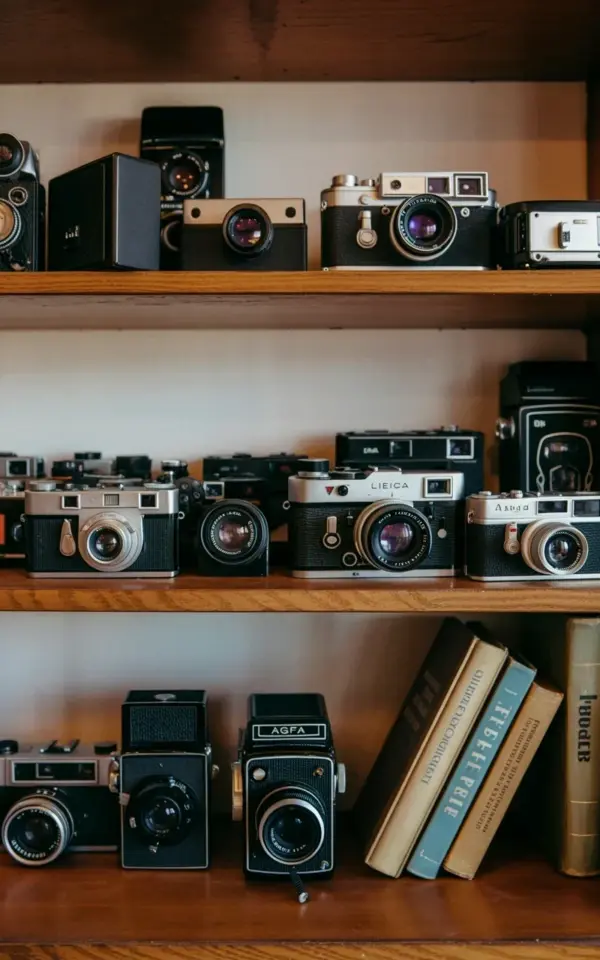
Every time I scroll past a photo of a shelf like this, I stop. It’s not just the cameras, it’s the quiet way they sit there, black and silver bodies catching the light, old books leaning in like they have nowhere else to be. If you’re staring at your own collection right now, wondering why it doesn’t look this good, the answer isn’t more cameras. It’s how you’re arranging the ones you already have.
Most people mess up vintage camera decor in the exact same ways. They crowd too much together, they ignore the backgrounds, and they treat every shelf like a storage bin instead of a display. This guide is about the mistakes, and honestly, the fixes are easier than you think.
The Museum Shelf Mistake: Cramming Everything Into One Spot
A shelf full of cameras should feel like a curated gallery, not a yard sale. The worst thing you can do is line up twenty cameras shoulder to shoulder with no breathing room. I see it all the time, people shove a Leica next to a plastic point-and-shoot next to a broken flash unit, and the whole thing just becomes noise.
The fix is to edit ruthlessly. Choose three to five pieces that share a visual language. In the photo we’re talking about, the top shelf holds black and silver film cameras with a few lenses scattered around, and that works because they all have that same mechanical, precision-built character. If a camera doesn’t add to the story, put it in a drawer. Seriously, let the good ones breathe.
Take a look at the middle shelf in that image. The rangefinder cameras are arranged in a deliberate line, a black Leica sitting next to a silver one. It’s a simple pattern, but it reads as intentional. That’s the whole secret: make it look like you chose that exact spot for that exact camera.
How to Mix Vintage Film Cameras with Books Without Making a Mess
Every film photography lover has a stack of old books, and they always want to mix them into the display. The problem comes when the books become a random pile of clutter at the base of the shelf. It looks like you just dumped your coffee table onto the floor.
The bottom shelf in our inspiration photo does it right. Two black Agfa cameras sit there, sturdy and bold, with several vintage books leaning against them. The books aren’t stacked flat and forgotten. They’re propped up at a slight angle, acting as a backdrop and a support structure for the cameras.
Here’s the thing about mixing books and cameras: the books should anchor the scene, not compete with it. Use hardcover books with worn spines and muted colors. Let them lean, don’t stack them perfectly. Imperfection here looks human. That’s what gives the shelf that cozy, darkroom vibe instead of a sterile showroom look.
Don’t Throw Away the Lenses and Accessories, But Don’t Let Them Take Over
Part of the appeal of a film camera collection is the stuff that goes with it. Lenses, viewfinders, lens caps, little leather cases. They add texture and tell a story about how the camera was actually used. But here’s the mistake: people treat accessories like a pile of junk to be shoved into a corner.
In the image, the top shelf has various lenses and camera accessories scattered among the cameras. That works because they’re spread out, not clustered. A single lens resting in front of a camera body looks like it’s waiting to be mounted. A cluster of six lenses just looks like you have a lot of stuff.
My advice is to group accessories near the camera they belong to. Pair a 50mm lens with the screw-mount Leica it would have lived on. Keep a light meter next to the Agfa it would have been used with. This turns clutter into context. It also gives you a natural reason to switch up the layout whenever you get bored, which honestly happens more often than you’d think.
Forgetting That Cameras Need “Breathing Room”
Ok so this sounds like a weird thing to say, but trust me. A camera that is crammed right up against another camera loses all its visual weight. These machines have distinct silhouettes. The Leica rangefinder has that flat, precise top plate. The Agfa has that bulky, classic body. When you press them together, you kill the shapes.
Let each camera have a little zone of empty space around it. You don’t need a foot of gap, just enough that the eye can trace the outline of the body without hitting the next object. On a standard wooden shelf, that usually means one camera per foot of shelf space, maybe two if you’re working with a long row. The middle shelf in the photo has five or six cameras lined up, but each one is still individually readable. That’s the goal.
Also, keep in mind the importance of the back of the shelf. A camera that is pushed all the way back against the wall gets lost in shadow. Pull it forward an inch or two. Let the light catch the silver edges of the lens barrel and the knurled focusing rings. Shadows are great, but you want a little bit of highlight to define the shape.
Matching the Darkroom Vibe With the Right Wood and Wall Tone
The background in the photo is doing a lot of the heavy lifting. Warm wooden shelves, a moody wall, subtle lighting. That’s the museum-like atmosphere people are actually drawn to. But a lot of folks try to recreate this look on a bright white IKEA shelf, and it just falls flat.
Here’s a blunt opinion: white shelves are the enemy of vintage camera decor. The stark contrast makes black cameras look like holes and silver cameras look washed out. Wood, on the other hand, adds warmth and a sense of history. If you can’t swap your shelving, consider placing a dark wooden cutting board or a slab of walnut on top of the shelf to create a base for the cameras to sit on.
That little trick changes everything. It grounds the camera and gives you a controlled backdrop. You can do the same with old leather-bound books, placing them flat to act as a pedestal. Anything that introduces a darker, richer tone is going to make those silver Leica bodies pop.
Making It a Photography Gift Without Making It Look Like a Gift
This whole setup is a perfect photography gift idea for the film photography lover in your life. But, and this is a big but, it looks terrible when you just wrap a camera and hand it to someone. The gift is in the curation. The presentation is the present.
What I mean is this. If you’re giving a vintage Leica as a gift, don’t hand it over in a plastic bag. Put it on a small shelf. Set it next to an old book about darkroom techniques. Tuck a roll of film in front of it. Let the person walk into the room and see it already placed, already part of the house. The reaction is so much better.
The phrase “photography gift” often makes people think of buying a new lens or a camera strap. But the more meaningful gift is the arrangement. When you display a camera like it belongs in a museum, you’re telling the person that their hobby matters. You’re honoring the object. That beats a gift receipt any day of the week.
- Use warm wood tones as the base, never bleach white.
- Pick one hero camera for each shelf, maybe two.
- Angle the books, don’t stack them perfectly flat.
- Group lenses with their matching bodies.
- Let the cameras slide forward a bit to catch the light.
- Keep the color palette muted: black, silver, leather brown, wood.
The whole point of this look is to feel collected over time, not styled in an afternoon. But here’s the honest truth: nobody can tell the difference, so fake it. Arrange things slowly. Step back. Move one camera a half inch to the left and see if it clicks. That fussy behavior, the adjusting, the tilting of the books, that’s the fun part. And it’s the only way to get a display that looks like it grew there instead of being placed there by someone with a credit card.
A good vintage camera shelf is never finished. You’ll get a new lens and swap it in. You’ll find a book with a better spine and replace the one that’s currently holding up the Agfa. That’s natural. That’s what makes the collection feel alive. Just keep the mistakes we talked about in mind, and you’re already doing better than half the people posting their shelves online. Now go move one of those cameras and see what changes.
Leave a Comment